
How Akoya Pearls Are Cultured: Oyster Farming Explained
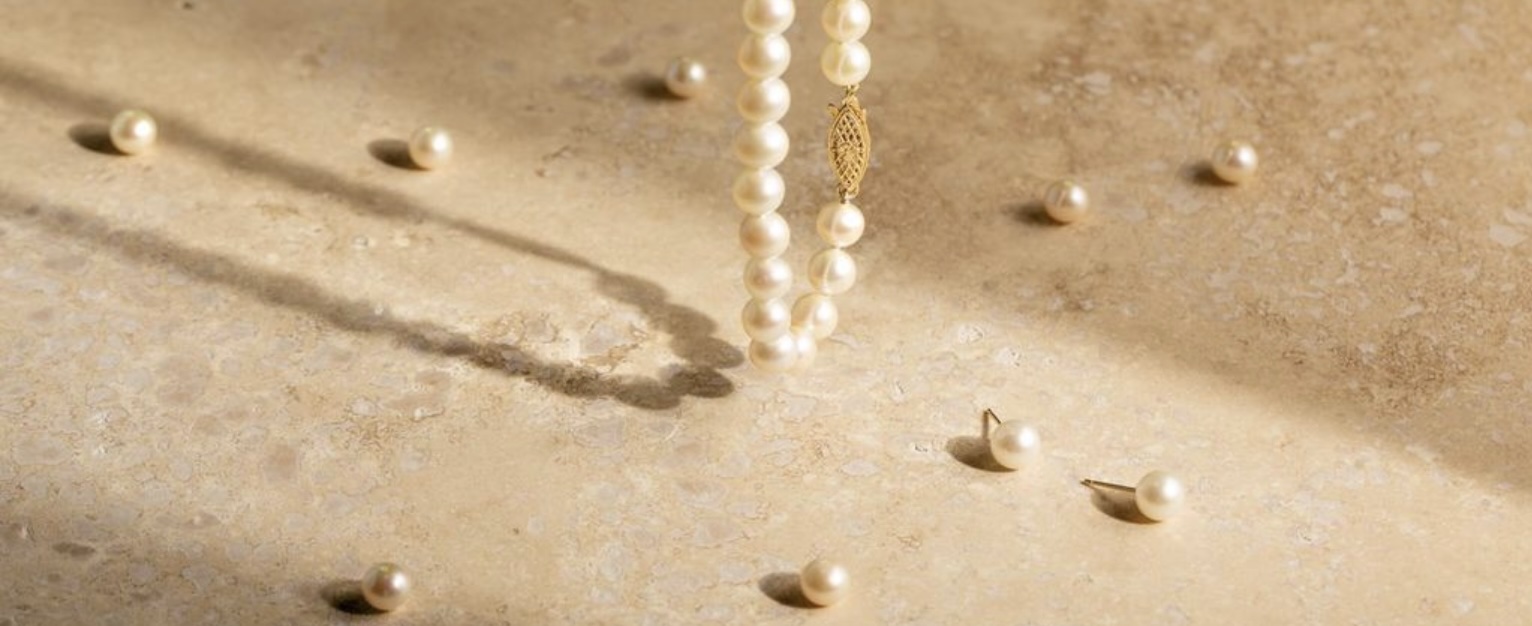
Akoya cultured pearls are usually produced by pearl oysters in the Pinctada fucata species complex. A trained technician inserts a bead nucleus and a small piece of donor mantle tissue; if the oyster recovers and retains the implant, a pearl sac deposits nacre around the bead over time. For a broader look at the type itself, see our Akoya pearls hub.
Key takeaways:
Akoya cultured pearls are produced in oysters from the Pinctada fucata species complex, farmed across parts of Japan and other Asian pearl-growing regions. Akoya oysters aren’t simply “larger” than freshwater mussels—the two differ in species, environment and cultivation method, not just size. The Pearl Source’s overview of Akoya oysters covers the species in more depth.
Akoya oysters may be produced through hatchery spawning or collected as juveniles, depending on the farm. Young oysters typically pass through nursery stages before being gradually moved to farm conditions as they mature. Specific hatchery methods vary by region and operation—what one hatchery does isn’t necessarily standard everywhere.
Before nucleation, oysters are selected and conditioned by farm staff. This may involve careful handling and monitoring in the lead-up to surgery, though there’s no single universal medication, fasting or conditioning regimen used across every farm.
A trained technician surgically inserts a shell bead nucleus along with a small graft of donor mantle tissue into the oyster’s gonad. According to GIA, the bead alone doesn’t create nacre—it’s the donor tissue that forms the pearl sac, which then deposits nacre around the bead over time. Our guide on how pearls are made covers this process across pearl types.
After surgery, oysters need time to recover. Some may reject the nucleus, fail to survive the procedure, or ultimately produce a result that doesn’t meet quality standards. Recovery and retention rates vary by farm, season, stock and technique—there’s no reliable universal percentage for how many oysters make it through this stage successfully.
Once a nucleus is retained, the pearl sac deposits nacre around it over an extended growing period. A recent GIA field report describes a typical period of roughly 10–14 months in that specific context—worth noting as a sourced example, not a rule that applies to every farm or season.
| Stage | What Happens | Typical Duration |
| Hatchery and juvenile care | Oysters are spawned or collected, then raised through nursery stages | Varies by hatchery and region |
| Grafting preparation | Oysters are selected and conditioned ahead of surgery | Varies by farm |
| Bead-and-tissue nucleation | A technician inserts a bead nucleus and donor mantle tissue | A single procedure per oyster |
| Recovery | Oysters rest in controlled conditions to recover from surgery | Varies by farm and season |
| Growing period | The pearl sac deposits nacre around the bead | Often many months; one GIA field report describes roughly 10–14 months as typical in that context |
| Harvest | The oyster is opened and the pearl is removed | — |
| Sorting and processing | Pearls are cleaned, sorted, matched and sometimes processed | Varies |
Ongoing farm husbandry may include housing oysters in baskets or nets, regular cleaning to remove fouling organisms, monitoring water quality, and moving oysters seasonally to more favorable conditions. These are practices some farms use, not universal requirements—methods vary by operation and region.
How a pearl’s nacre develops—and how it ultimately looks—depends on the oyster’s health, the length of the growing period, environmental conditions and farm practices, among other factors. A longer growing period doesn’t automatically produce a better-quality pearl; more time is one variable among several, not a guarantee. See our guide to Akoya colors for more on how these pearls typically appear.
At harvest, the oyster is opened and the pearl is carefully removed. Not every oyster is discarded after a single harvest—practices vary, and some oysters may be re-nucleated and returned to the water depending on their condition and the farm’s approach.
After harvest, pearls are cleaned, sorted and matched by size, shape, color and luster. Some pearls undergo processing, such as bleaching or pinking. FTC guidance says sellers should disclose treatments that are not permanent, require special care or significantly affect value.
Whether an operated oyster ultimately produces a marketable pearl depends on genetics, the skill of the grafting technician, the oyster’s health, nucleus retention, water conditions, growing duration and overall farm practices—the same quality factors that matter across pearl types. Exact production odds shouldn’t be quoted as a fixed rule unless they’re tied to a specific, primary study and its context.
Akoya farming is a human intervention in a living animal’s life cycle, and outcomes vary by farm, method and region. It isn’t accurate to claim that every farm improves its surrounding ecosystem, or that every farming method is entirely harmless—these claims need specific, verifiable evidence rather than blanket reassurance. At the same time, there’s no basis for assuming every farm is harmful either; general bivalve ecology and verified outcomes at a specific farm are two different things and shouldn’t be conflated.
Japan has a long history with Akoya cultivation and remains an important producer today, but it isn’t the only source. Vietnam and China are also significant Akoya-producing regions, each with their own farming practices and conditions. Akoya pearls shouldn’t be assumed to come from one single country.
Are Akoya pearls real?
Yes. They’re cultured pearls formed by living pearl oysters after human implantation—not imitation pearls.
How many pearls does an Akoya oyster produce?
A bead-nucleated operation generally targets one pearl at a time, but farm practices and re-operation decisions vary, so there’s no universal lifetime rule for how many pearls a single oyster produces.
How long do Akoya pearls grow?
Often many months. A recent GIA field report describes roughly 10–14 months as typical in that context, though this shouldn’t be treated as a guarantee across every farm and season.
Why are some Akoya pearls rejected?
The implant may be rejected, the oyster may not survive the procedure, or the result may not meet quality standards. Rates vary by farm and shouldn’t be guessed at with an invented percentage.
Are Akoya pearls always perfectly round?
No. Bead nucleation supports roundness, but shape and quality still vary from pearl to pearl; careful sorting is what creates highly matched, uniform-looking strands.
Akoya culture is a controlled beginning followed by biological growth. Skill, husbandry and environment all influence the result, but no farm can guarantee that every oyster will produce a gem-quality pearl.
Signup now and receive an email once I publish new content.
